

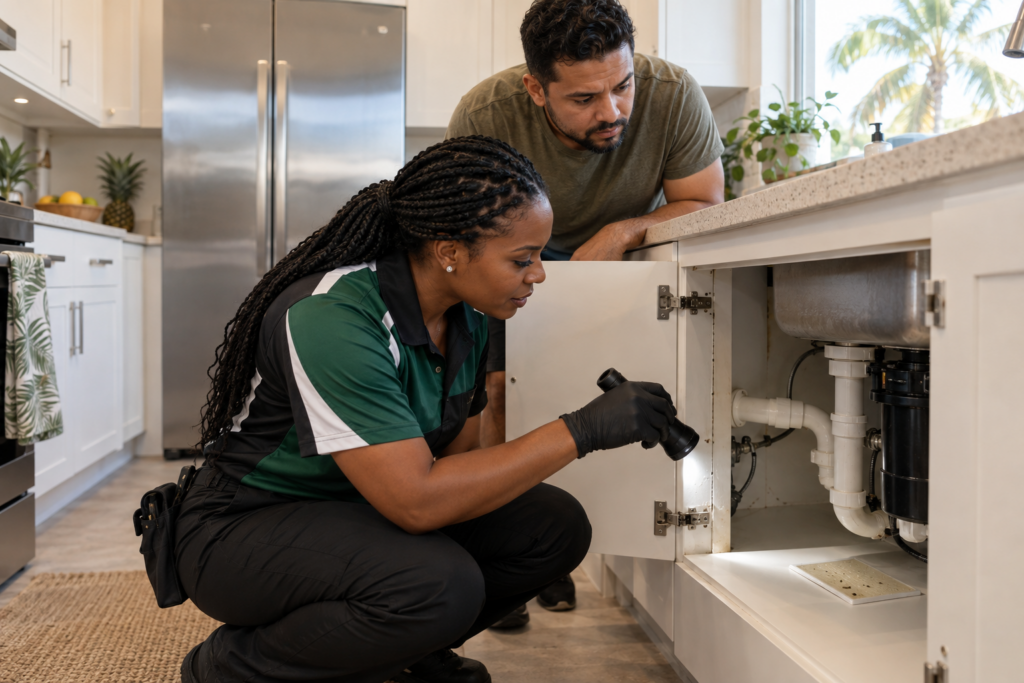
You wipe down the kitchen, spray the roach you can see, and enjoy a quiet night. Then another appears beside the refrigerator—and a much smaller one disappears into a cabinet hinge. German cockroaches make people feel as if nothing works, but the problem is usually not a lack of effort. It is that this indoor species is built to survive incomplete treatment.
German roaches are hard to eliminate because they reproduce quickly, carry protected egg cases until nearly hatch time, hide in tight warm spaces, live close to food and water, and can resist or avoid treatments that are used repeatedly. Lasting control usually requires accurate identification, monitoring, targeted bait or other professional treatment, sanitation, moisture correction, exclusion, and follow-up—not a one-time spray.
First, make sure it is a German cockroach
Adult German cockroaches are small—about 3/8 to 9/16 inch long—with two dark parallel stripes behind the head. Nymphs are smaller and darker. They are strongly associated with indoor human environments and commonly gather near kitchens, bathrooms, break rooms, and other places with moisture, warmth, food residue, and narrow hiding spaces.
That is different from the large outdoor cockroaches South Floridians often call palmetto bugs. A large roach that wanders in after rain may call for exterior entry-point work, while multiple small roaches and nymphs around an appliance often indicate indoor breeding. Compare our German Cockroach guide, broader Cockroaches guide, and Palmetto Bug guide before choosing a response.
Six reasons German roaches keep coming back
1. One egg case can hold 30 to 40 eggs
UF/IFAS reports that a typical German-cockroach egg case contains 30 to 40 eggs. The female carries the case until just before hatch, and the young may emerge while it is still attached. That protection helps explain why killing visible adults does not necessarily stop the next wave.
2. Generations overlap
The life cycle can be completed in roughly 100 days under favorable conditions, and breeding can continue with eggs, nymphs, and adults present together. UF/IFAS notes that an actively growing field population may be about 80% nymphs. A treatment that reaches only foraging adults can leave most of the population untouched.
3. Their hiding places are close to the resources they need
German roaches flatten into cabinet seams, appliance voids, drawer tracks, wall penetrations, motor housings, and gaps around plumbing. In a South Florida kitchen, a refrigerator compressor, dishwasher cavity, sink leak, condensation line, or coffee station can provide the combination of warmth, moisture, and crumbs they need within a few feet.
4. Tiny food and water sources are enough
A visibly clean countertop does not mean every resource is gone. Grease beneath a stove, crumbs in a drawer track, pet kibble, residue around a recycling bin, water beneath a sink, or condensation behind an appliance can compete with bait and sustain hidden roaches. Sanitation matters, but an infestation is not proof that a resident or business is careless; roaches can arrive in boxes, bags, used appliances, deliveries, or from an adjoining unit.
5. They can resist or avoid repeated treatment
German-cockroach populations have documented insecticide resistance, and some may avoid a bait matrix they no longer find attractive. Repeatedly applying the same product or spraying on a routine schedule can select for survivors. This is one reason professionals inspect, monitor results, place treatment precisely, and adjust the plan when activity does not fall as expected.
6. Connected buildings can reintroduce them
In apartments, condos, offices, restaurants, and other shared structures, roaches can move through pipe chases, wall voids, gaps beneath doors, and shared service areas. Treating one kitchen while an adjacent source remains active can produce temporary improvement followed by a return. See our guidance for roaches in apartments and the site’s apartment and condo pest-control service.
Why spray-and-go treatments often disappoint
A contact spray may kill a roach in the open, but it does not automatically reach protected egg cases or hidden nymphs. Broad spraying can also contaminate bait placements or make a treated area less attractive, reducing the chance that foraging roaches feed on the bait. Total-release foggers add fire and exposure risks and should never be treated as a complete control plan.
The CDC specifically advises people managing asthma triggers to avoid sprays and foggers. If anyone in the home has asthma or chemical sensitivity, tell the pest-control provider before service so the inspection and treatment plan can account for that. Always follow the pesticide label; more product is not better.
What effective German-roach control looks like
Identify and map the activity
Start with a flashlight inspection and sticky monitoring traps near suspected harborages—not in the middle of the room. Record catches by location and date. A trap behind the refrigerator may reveal a different pressure point from one beneath the sink, and the pattern tells the technician where to focus.
Reduce competing food, water, and clutter
- Wash dishes and wipe spills before night.
- Clean grease and crumbs under and beside appliances.
- Store pantry goods and pet food in sealed containers.
- Empty indoor trash and rinse food containers before recycling.
- Repair sink, dishwasher, refrigerator, and air-conditioning leaks.
- Remove excess cardboard, paper bags, and crowded cabinet liners.
Use targeted treatment where roaches travel and hide
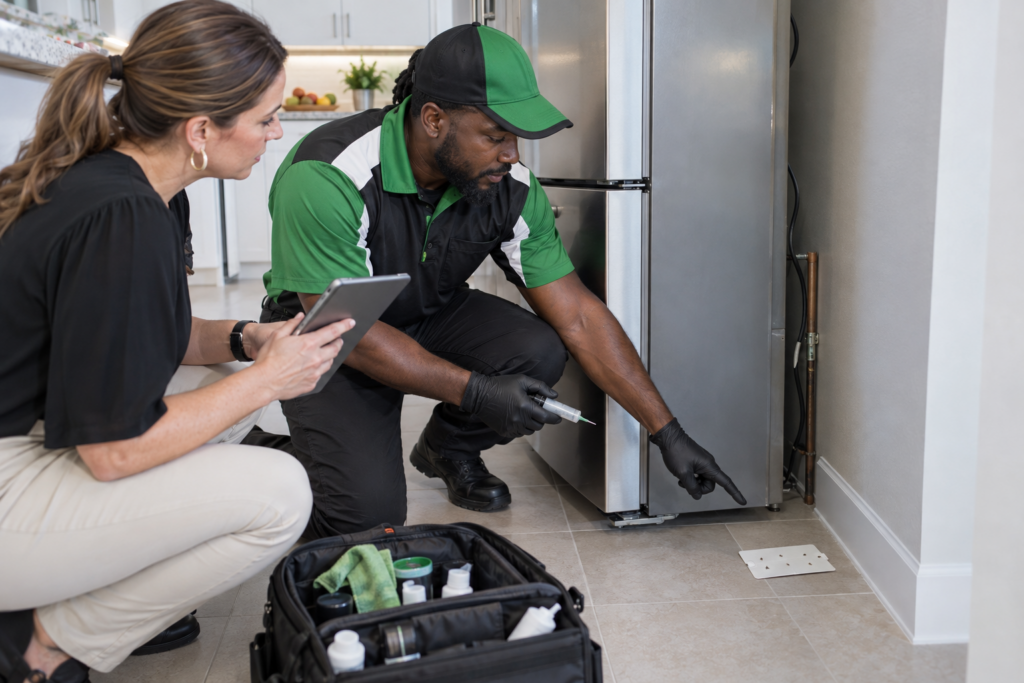
Gel baits and enclosed bait stations can be effective when placed according to the label near harborages and when competing food is reduced. Professionals may also use insect growth regulators or other crack-and-crevice tools based on the site, occupants, and infestation level. Treatment must stay out of reach of children and pets and away from food-contact surfaces.
Seal harborages and routes after the pressure drops
Caulk cabinet seams, close gaps around plumbing, repair loose backsplashes, add door sweeps where appropriate, and correct openings between units or shared spaces. Do not block required appliance ventilation or access panels. Our Cockroach Control and Kitchen Pest Control pages explain how targeted service fits a broader prevention plan.
Follow up until the monitors stay quiet
Baits are not an instant knockdown, and egg cases present during the first visit may still hatch. Follow-up lets the technician compare trap counts, replace or reposition bait, look for missed moisture, and decide whether neighboring areas require inspection. Improvement should be measured, not guessed.
What to do in the next 24 hours
- Take a clear photo or save a specimen in a sealed container for identification.
- Place sticky monitors along wall edges behind the refrigerator, beside the stove or dishwasher, and beneath the sink.
- Dry sinks and counters overnight and fix active leaks.
- Seal food and remove trash, including pet food and food residue in recycling.
- Do not spray over bait or mix products in the same cracks.
- Tell management if you are in a multi-unit building; coordinated inspection may be necessary.
- Schedule professional help when you see nymphs, egg cases, daytime activity, or repeat sightings in more than one room.
For a focused kitchen plan, see Get Rid of German Cockroaches in Your Kitchen and Get Rid of Roaches in Kitchen Cabinets.
When to call a pest-control professional
- You see small roaches or nymphs during daylight.
- Activity occurs in several rooms or returns after DIY treatment.
- You find egg cases, heavy droppings, or a persistent musty odor.
- The property has shared walls, plumbing, kitchens, or trash areas.
- Children, pets, older adults, or people with asthma require a carefully managed plan.
- You run a restaurant, commercial kitchen, childcare site, clinic, or other sensitive business.
In Touch Pest Control can combine identification, monitoring, targeted treatment, sanitation guidance, and follow-up through our General Pest Control service. Commercial food sites can also review Commercial Kitchen Pest Control.
Frequently asked questions
Can German roaches be eliminated completely?
Yes, an indoor infestation can be eliminated, but success depends on reaching the hidden population and preventing reintroduction. Inspection, targeted treatment, sanitation, moisture repair, exclusion, and follow-up are usually more reliable than repeated contact spraying.
How long does it take to get rid of German roaches?
There is no single timeline. The infestation size, number of harborages, access to food and water, treatment history, and neighboring-unit pressure all matter. Activity may decline before egg cases finish hatching, which is why monitoring and follow-up are important.
Does seeing one German cockroach mean there are more?
One confirmed German cockroach deserves inspection because this species lives and breeds indoors. It may be a newly introduced hitchhiker, but nymphs, egg cases, repeated nighttime sightings, or trap catches strongly suggest an established population.
Are German roaches caused by a dirty house?
No. German roaches can be carried into clean homes in packages, grocery bags, used appliances, furniture, or deliveries, and they can move between connected units. Food residue, leaks, and clutter make control harder, but their presence is not a moral judgment about the occupant.
Should I use a bug bomb for German roaches?
No fogger should be treated as a complete German-roach solution. Foggers can create fire and exposure hazards, and they do not replace inspection, sanitation, targeted baiting, exclusion, and monitoring. Follow EPA safety guidance and the product label for any pesticide you use.
Stop treating the symptom and target the colony
German roaches are persistent, but they are not unbeatable. In Touch Pest Control will inspect the areas that matter, build a treatment plan around the actual activity, and follow up until the pressure is under control. Contact In Touch Pest Control to schedule service for your South Florida home or business.