Drywood termites are one of Florida’s most common indoor termite species. Unlike subterranean termites, they don’t need soil contact or moisture – instead, they live entirely within the wood they consume.
They quietly hollow out furniture, baseboards, and attics, leaving only a thin shell behind. Because infestations often go undetected for months or years, early inspection and treatment are essential to prevent costly repairs.
What Drywood Termites Look Like
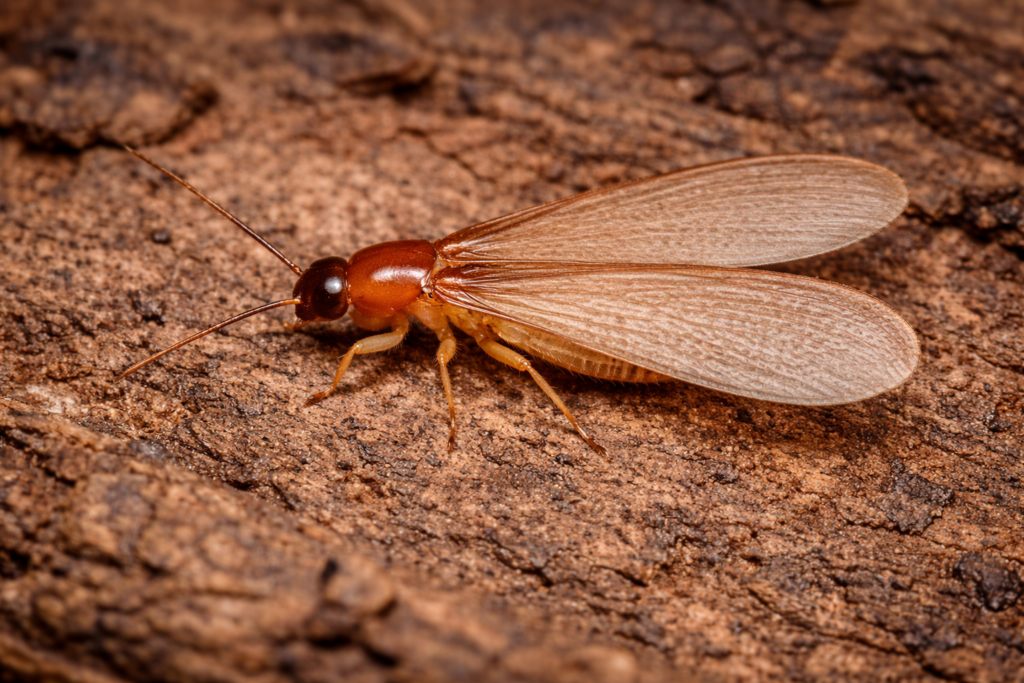
Drywood termites are small, ranging from ⅜ to ½ inch long, and vary from light brown to tan depending on age and colony stage. Their wings are clear with veins running along the edge, and swarmers are often attracted to indoor lights during warm evenings.
Key identifying features include:
Two equal-length pairs of wings (longer than their bodies).
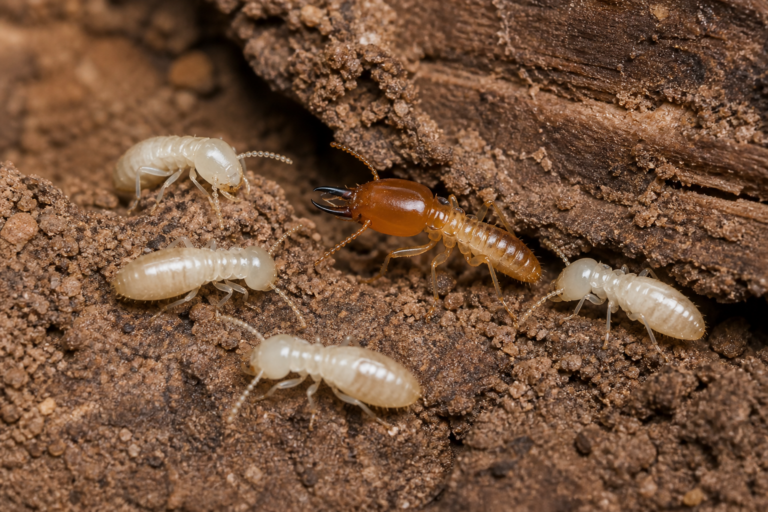
Cream-colored workers and pale brown soldiers.
Distinct pellet-like droppings (frass) near infested wood.
Drywood termites live entirely inside wood, creating smooth, maze-like galleries. They do not build mud tubes or rely on external moisture sources. Colonies are typically smaller (1,000–5,000 members) but spread slowly through infested furniture or framing.
Common nesting sites include:
Roof trusses and attic beams
Wooden furniture or picture frames
Baseboards and window sills
Wooden doors, floors, and decorative trim
Cracks in hardwood flooring
Signs of a Drywood Termite Infestation
Small piles of sand-like droppings (frass) near infested areas
Hollow or blistered wood surfaces
Tiny kick-out holes used to push out waste
Swarmers (winged termites) emerging at night
Clicking or rustling sounds inside walls
⚠️ If you find both frass and small exit holes, it’s a sure sign of an active colony. Contact us Today >>
Drywood Termite FAQs
What do drywood termite droppings look like?
They resemble tiny, six-sided, sand-like pellets — usually tan or brown — found beneath infested wood.
Can drywood termites spread between homes?
Yes. Swarmers can fly short distances and start new colonies in nearby houses or furniture.
How serious is a drywood termite infestation?
They cause gradual but severe damage over time, especially in attics and furniture.
Do I need fumigation for drywood termites?
Localized infestations can often be treated with spot or foam applications. Large colonies may require fumigation.
Drywood termites can silently hollow out your furniture and wood framing. Our experts identify infested areas and use advanced spot and fumigation treatments to eliminate colonies for good.
Seeing droppings or swarmers around your home? Request your free quote today and protect your property before damage spreads.
Termite Treatment & Prevention Guide
Explore termite treatment pages, early warning signs, and prevention guides. This section updates automatically as new termite-specific pest solution pages are added and tagged to the Termites relationship.
Drywood termites feed across the grain of wood, leaving smooth-walled galleries and weakened structures. Over time, this can compromise window frames, ceilings, or entire roof trusses.
Common Damage Examples:
Hollow furniture or decorative wood trim
Bubbling or cracked paint revealing tunnels beneath
Weakened baseboards or window sills
Sagging or warped hardwood floors
💡 The earlier the infestation is found, the more likely it can be treated without full fumigation.
How to Get Rid of Drywood Termites
DIY Steps
Inspect attic and crawl spaces for droppings.
Vacuum visible frass and seal entry cracks.
Place infested furniture outdoors in sunlight (temporary relief).
Avoid store-bought sprays — they rarely reach deep colonies.
Professional Treatment
Our licensed termite technicians use proven methods to eliminate drywood termites safely and completely, including:
Avoid storing untreated wood or cardboard in attics.
Schedule annual termite inspections.
Keep attic humidity low with proper ventilation.
When to Call a Professional
If you’ve discovered droppings, hollow-sounding wood, or swarmers inside your home, you likely have drywood termites. store-bought products won’t reach their sealed galleries inside walls or furniture.
Our team identifies hidden colonies, provides the right treatment plan, and helps prevent future infestations.
Trustindex verifies that the original source of the review is Google.
Great service for the price tbh
Alexzay Rodriguez
2025-06-02
Trustindex verifies that the original source of the review is Google.
Goat services and didn’t have a problem ever sense.
Mawite
2025-06-02
Trustindex verifies that the original source of the review is Google.
Best service hands down!! As a first time customer, all I know is this they definitely got the job done and will be recommending them to everyone
shay starz
2025-04-23
Trustindex verifies that the original source of the review is Google.
I been having a bugs everywhere and been terrified and they help me so much getting the bugs away
Jayden Trashbag
2025-04-23
Trustindex verifies that the original source of the review is Google.
Did an amazing job helping me with my ants .
Sade Bennett
2025-04-23
Trustindex verifies that the original source of the review is Google.
I was having problems with my roaches in my house and they did a good job getting rid of em
Tll god
2025-04-23
Trustindex verifies that the original source of the review is Google.
this man does really good he killed all the pests in my house 😮🫡
Suzanne Stewart
2025-04-07
Trustindex verifies that the original source of the review is Google.
Very accommodating for emergency service request. Also prompt in time for appointments. Great company!!
Verified by Trustindex
Trustindex verified badge is the Universal Symbol of Trust. Only the greatest companies can get the verified badge who has a review score above 4.5, based on customer reviews over the past 12 months. Read more
We use cookies for a better browsing experience, Learn More.