

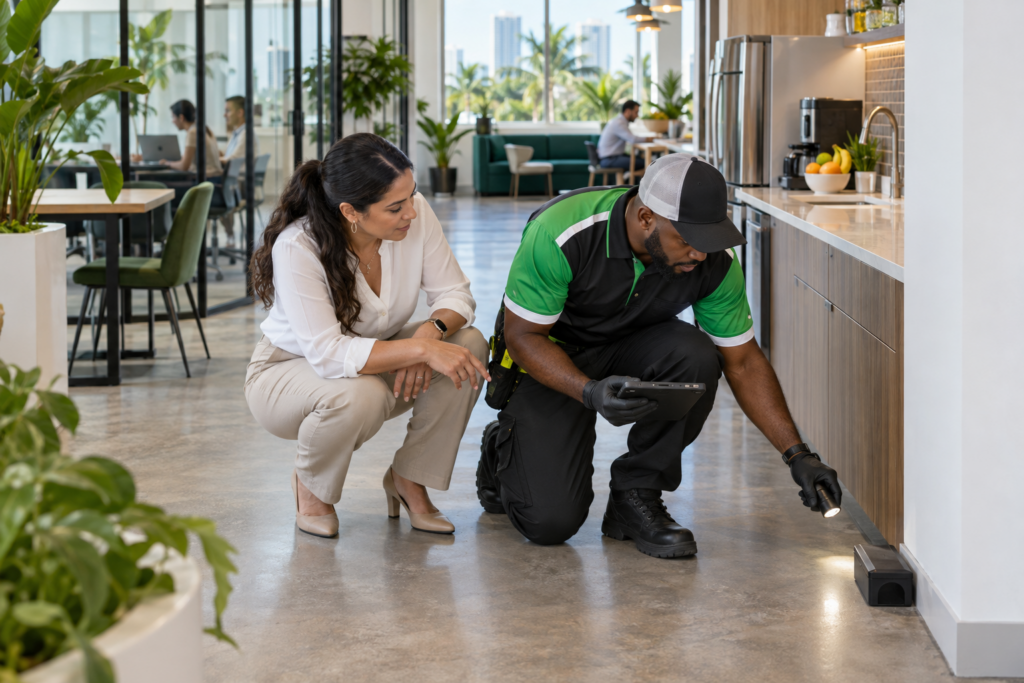
A pest sighting in a shared office spreads fast: one ant trail at the coffee station becomes a team chat topic, a roach near reception unsettles visitors, and rodent evidence in a storage room can turn into a facilities emergency. The good news is that most office pest problems are easier to prevent when the building, cleaning team, occupants, and pest-control provider follow one coordinated plan.
The best pest control for office buildings and shared workspaces is an integrated pest management (IPM) program built around inspection, monitoring, sanitation, moisture correction, entry-point sealing, clear reporting, and targeted treatment only where evidence shows it is needed. In South Florida, that plan should cover both the conditioned interior and the warm, humid exterior pressure around doors, landscaping, loading areas, roofs, and trash zones.
Why clean offices can still develop pest problems
An office does not need to look dirty to support pests. Shared kitchens, personal snack drawers, coffee residue, refrigerator drip pans, sink leaks, cardboard deliveries, indoor plants, floor drains, and gaps around utility lines can provide food, water, or shelter. Hybrid schedules add another wrinkle: food may sit unnoticed over a long weekend, while quiet areas give pests time to forage.
South Florida’s long warm season allows many insects to remain active for much of the year. Heavy rain can also push ants, large outdoor cockroaches, and other occasional invaders toward dry buildings. Offices near restaurants, canals, dense landscaping, shared dumpsters, or multi-tenant service corridors may face pressure that starts beyond their own suite.
The office pests facilities teams should watch for
Ants around sinks, coffee stations, and windows
Tiny ghost ants and other Florida pest ants can follow moisture and sweet residue into break rooms, restrooms, planters, and desk areas. UF/IFAS notes that ghost ants are established in Florida, especially from Sarasota and Orlando south, and can nest in wall voids, cabinetry gaps, and potted plants. Wiping away the visible trail helps temporarily, but the source and entry route still need attention. Learn more in our Ants guide.
Cockroaches in break rooms and equipment voids
Small German cockroaches can hitchhike in boxes, food deliveries, bags, or used equipment and then hide near refrigerator motors, cabinet seams, appliances, and plumbing. Larger outdoor roaches may enter under doors or through openings after wet weather. Multiple small roaches or nymphs call for a prompt inspection because they can indicate indoor breeding. Compare common species in our Cockroaches guide.
Rodents in ceilings, storage rooms, and service areas
Roof rats and mice may use tree limbs, roof penetrations, loading areas, utility chases, or gaps beneath exterior doors. Warning signs include droppings, gnawing, rub marks, shredded material, noises above ceilings, and disturbed food. Do not sweep or vacuum dry droppings; isolate the area and follow appropriate cleanup guidance. Our Rodents guide explains the signs in more detail.
Flies near drains, trash, and food residue
Fruit flies, drain flies, and larger filth flies point to different sources. A treatment will not hold if organic buildup remains in a drain, food residue sits beneath equipment, or a dumpster lid and door seal are failing. Correct identification keeps the team from cleaning the wrong place.
Bed bugs carried into flexible work areas
Bed bugs do not live on crumbs and are not a sign of poor sanitation. They can be transported on personal belongings and may be discovered in lounge seating, locker areas, or offices used by frequent travelers. A suspected specimen should be preserved for identification, and the affected area should not be treated with random sprays or moved furniture.
A practical IPM plan for offices and coworking spaces
The U.S. EPA describes IPM as a prevention-focused approach that identifies pests, monitors activity, sets action thresholds, removes food, water and shelter, and uses the most effective lower-risk control options when action is needed. In an office, that becomes a repeatable facilities process rather than a reaction to the loudest complaint.
1. Assign one reporting route
Give employees and tenants a simple way to report the pest, exact location, time, and a photo when safe. Route reports to one facilities contact instead of allowing independent DIY treatments. A map of repeat sightings can reveal a plumbing chase, door, planter, or neighboring suite that isolated complaints would miss.
2. Inspect and monitor before treating
Inspect wall-floor junctions, appliance voids, sink cabinets, janitor closets, reception areas, utility penetrations, storage rooms, loading points, and exterior doors. Date and number discreet monitors so results can be compared over time. A documented pest-monitoring program shows whether activity is falling, moving, or returning.
3. Remove food and water without blaming occupants
- Clean coffee, syrup, and creamer residue each day.
- Store communal food in hard, sealed containers and date it.
- Set a weekly refrigerator cleanout and a nightly trash schedule.
- Vacuum crumbs from desk areas, conference rooms, and upholstered lounges.
- Repair sink, ice-maker, refrigerator, and HVAC condensate leaks promptly.
- Rinse recycling and keep waste containers closed and clean.
4. Close the building’s easy entry points
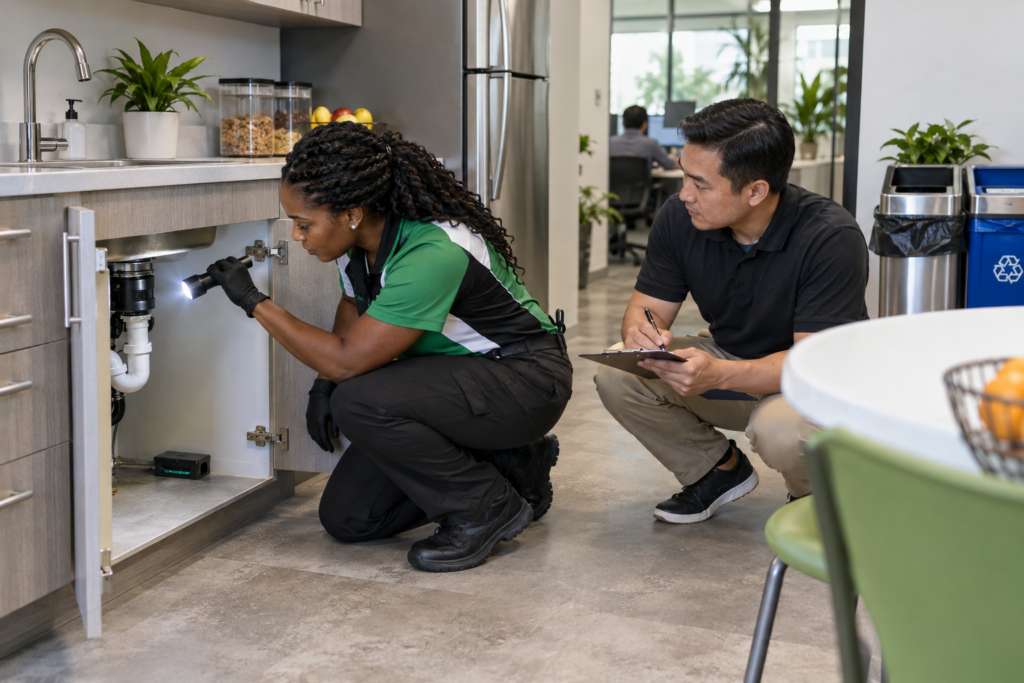
Repair door sweeps, weather stripping, screens, wall penetrations, pipe gaps, and damaged loading-door seals. Keep plants and stored materials from touching the building, and review branches that provide roof access. UF/IFAS notes that if light is visible through an exterior gap, it is large enough for many Florida pests to enter. Our Entryway & Door Sweep Protection and Rodent Exclusion pages show how exclusion supports treatment.
5. Target treatment to evidence and risk
When monitoring confirms activity, the treatment should match the pest and location. Depending on the finding, a professional may use trapping, physical removal, heat or cold, baits, crack-and-crevice applications, or another label-approved method. UF/IFAS advises that pesticides should follow a thorough inspection and notes that targeted crack-and-crevice treatments and baits generally create less exposure than broadcast applications.
For shared spaces, tell the provider about sensitive occupants, food-contact areas, pets in pet-friendly offices, air-handling concerns, and access restrictions. Florida regulates structural pest-control work, so businesses should use an appropriately licensed provider and keep service documentation available.
6. Recheck the conditions, not just the trap
A closed work order is not the same as a solved source. Follow-up should confirm that leaks were repaired, food practices changed, entry points were sealed, monitors improved, and adjacent areas stayed quiet. EPA building guidance recommends keeping organized records of pest service, pesticide applications, nonchemical measures, and prevention recommendations.
A weekly office pest-prevention checklist
- Break room: check beneath the sink and appliances; remove expired food; clean residue.
- Workstations: remove open food, cups, and overflowing desk bins.
- Restrooms and janitor closets: report leaks, drain odor, and damaged wall penetrations.
- Reception and lounges: inspect upholstered furniture after a credible pest report; do not relocate suspect items.
- Storage and IT rooms: reduce cardboard and keep access along walls for inspection.
- Exterior doors: look for daylight beneath sweeps and doors that do not close fully.
- Trash and loading areas: close lids, clean spills, and keep loose waste away from the building.
- Records: review new sightings and monitor results by exact location.
For a deeper break-room plan, visit Break Room Pest Control. Facilities teams can also review the dedicated Office Building Pest Control service page.
What to require from a commercial pest-control provider
- A site-specific inspection and pest trend log
- Clear service frequency, response time, and emergency-contact expectations
- Exact findings by suite, room, or monitoring point
- Written sanitation, maintenance, and exclusion recommendations
- Documentation of products and locations when pesticides are used
- Coordination with cleaning, landscaping, property management, and tenants
- Follow-up that measures results instead of simply repeating the same treatment
A coworking operator or multi-tenant property may also need a building-wide protocol defining who handles common areas, tenant suites, loading zones, landscaping, and after-hours access. In Touch serves offices alongside other property types listed on our Commercial Services hub.
Frequently asked questions
How often should an office receive pest control?
There is no universal schedule. Building age, food use, occupancy, neighboring businesses, landscaping, waste handling, pest history, and monitor results all matter. The right program sets an inspection and monitoring frequency for the actual risk, with extra service when evidence crosses the agreed action threshold.
Can pest control be performed after business hours?
Often, yes. Commercial service can usually be coordinated around occupancy and access needs. The provider should still follow the product label, communicate any preparation or reentry requirements, and document where treatment occurred.
Should employees spray pests they see?
No. Ask employees to report the location and provide a photo or specimen when safe. Uncoordinated spraying can create exposure, interfere with professional bait or monitoring, scatter some pests, and erase evidence needed to find the source.
Who is responsible in a shared office or multi-tenant building?
Responsibility depends on the lease and the source. Tenants may manage food and clutter within a suite, while property management controls common walls, roofs, exterior doors, landscaping, dumpsters, and shared plumbing. A coordinated inspection helps assign the corrective work without delaying control.
Does seeing one pest mean the office is infested?
Not always. A large outdoor roach after heavy rain may be an isolated invader, while a German-cockroach nymph, fresh rodent droppings, repeated ant trails, or several trap catches can indicate a more established problem. Identification and monitoring are the fastest way to tell the difference.
Build a quieter, cleaner pest-control program
The goal is not to wait for a visible pest—it is to make the office difficult to enter, feed in, hide in, and reproduce in. In Touch Pest Control can inspect your South Florida office, identify pressure points, set monitoring and service priorities, and coordinate with facilities or property management. Contact In Touch Pest Control for a commercial pest-control plan built around your workplace.
Sources and further reading
- U.S. EPA: Integrated Pest Management Principles
- U.S. EPA: Integrated Pest Management in Buildings
- UF/IFAS Extension: Urban Pests and Pest Management
- UF/IFAS Extension: Guide to Selecting a Pest Control Service
- UF/IFAS Extension: Ghost Ant
- Florida Department of Agriculture and Consumer Services: Pest-Control Business Licensing FAQ